The Archaeological Museum of Vathy, Samos: What to See
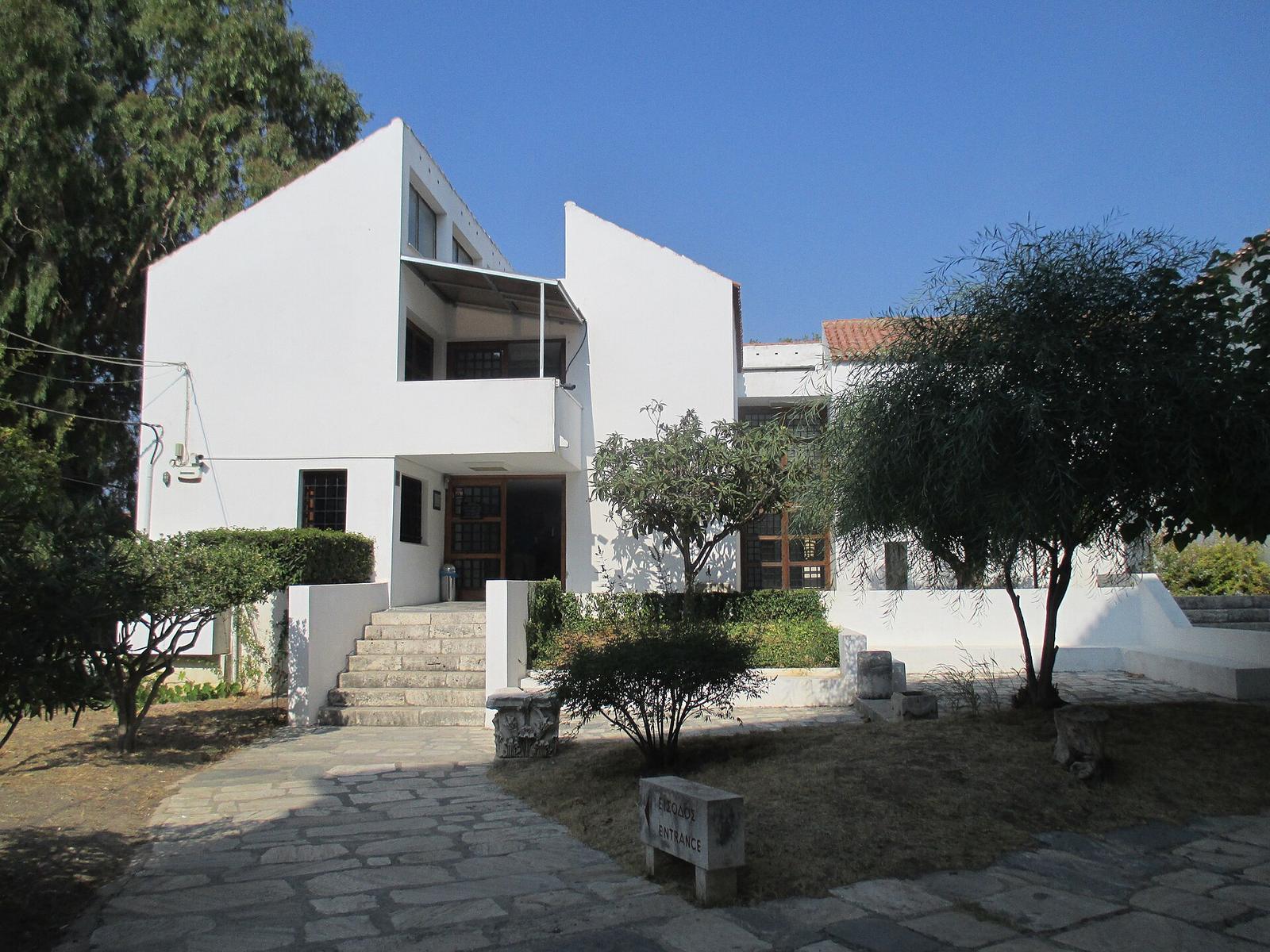
Vathy's museum holds the finds from the sanctuary of Hera, divided between a neoclassical building of 1912 and a second building added in 1984.

Summarize this article with:
The Archaeological Museum of Samos, in Vathy, keeps the material found at the sanctuary of Hera together with the island's collection of archaic sculpture, shown in two separate buildings. It stands in the island capital, which makes it easy to fit into a morning in the town, and it is the other half of any visit to the Heraion, since the objects found at the sanctuary itself are shown here.
Two buildings: the museum is spread across a two-storey neoclassical building put up in 1912 and a new building constructed in 1984. The two halves feel different from each other, so it helps to know which one holds what before you start, especially if your time in Vathy is short.
The 1912 building holds the material from the Heraion of Samos, statues and vases among it, together with offerings in bronze, ivory, wood and other materials. The 1984 building holds the sculpture collection, including important works of the archaic period, when Samos was at the height of its power.
Why the Heraion matters here. The sanctuary of Hera, about 6 km from ancient Samos, was the island's main sanctuary for a thousand years, and offerings reached it from across the ancient world. Standing among its foundations tells you the scale; the objects in Vathy tell you who came and what they brought.
What the offerings are made of. The faithful gave objects in clay, copper, wood, steatite, ivory, faience and limestone. A selection of these finds is shown in Vathy, and the range of materials is the point: it reflects how far the Heraion's influence reached, and its role as a crossroads where cultures met and traded.
A centre of sculpture. UNESCO describes the Heraion and the ancient city as adorned with splendid sculpture, which made Samos one of the great centres of sculpture in the Ionian world. The archaic works in the 1984 building belong to that tradition, so the sculpture hall is the part to linger in if you have little time.
The colossal kouros. In 1980, archaeologists searching for the main entrance of the Heraion found a colossal kouros by the sacred way, the road that linked the sanctuary to the city. It is now in the museum of Samos, and it is the clearest reminder that the island's sculptors worked on a monumental scale.
Pieces that left the island. Not everything found at the Heraion stayed on Samos. Around 560 BC an aristocrat named Cheramyes dedicated a kouros and three korai at the sanctuary, and one of those korai is now in the Louvre, known as the Hera of Samos, though it probably shows a priestess rather than the goddess.
What we could not confirm. The official listing describes the collections as groups, the Heraion offerings and the archaic sculpture, without naming individual pieces. We have therefore not printed a list of highlights or a count of exhibits: ask at the desk for the current layout rather than hunting for a specific object.
How the finds came to light. Travellers described the Heraion as early as 1702. Systematic digging began in the late 19th century, when Paul Girard found the Cheramyes statue in 1879, followed by the Greek Archaeological Society in 1902-1903. Those campaigns began to bring the sanctuary's offerings to light, the material now shown in Vathy.
Tickets: a full-fare ticket costs €10 and a reduced-fare ticket €5, and the museum also lists a special package at those same two prices. The reduced fare is granted to the categories set out in joint ministerial decision 117624, published in Government Gazette 1968/B/29-03-2024, article 2, a.
When the reduced fare applies. The reduced fare is valid between 1 October and 31 May each year only. In summer, from June to September, eligible visitors pay the full price like everyone else, so an off-season visit is the cheaper one if you qualify for a reduction.
Free admission: entry costs nothing on 6 March, in memory of Melina Mercouri, on 18 April for the International Day of Monuments, on 18 May for International Museum Day, on 28 October, and over the last weekend of September for the European Heritage Days. These dates follow no weekly pattern, so plan a free visit around the calendar.
Opening hours: the museum publishes 08:30 to 15:30, with the same timetable in winter and in summer, and it closes on Tuesdays. Last admission to Greek museums and sites is 20 minutes before closing. On Good Friday it opens later, from 12:00 to 17:00, and on Easter Sunday it is shut.
Other closed days. The museum also stays shut on 1 January, 25 March, 1 May, and 25 and 26 December. Since the Tuesday closure applies all year, a short stay on Samos can miss the museum entirely if that is the day you have set aside, so check the day of the week first.
Pairing it with the Heraion. The Heraion keeps the same 08:30 to 15:30 hours and is also closed on Tuesdays, so both fit on any other day but not in one afternoon. The simplest plan is the museum on one morning and the sanctuary on another, seeing the objects before or after the site.
From Pythagoreio by bus. If you stay in Pythagoreio, the KTEL bus to Vathy covers 14 km in about 20 minutes, with 8 departures on weekdays, 7 on Saturdays and 5 on Sundays, from 2 euros. In town the official tourism site recommends getting around on foot or by bicycle.
Address and contact: the museum's address is Plateia Dimarhiou, Vathi (Vathy), Samos, 831 00. The Ephorate of Antiquities of Samos can be reached on +30 22730 27469 or by email at efasam@culture.gr, which is the place to ask practical questions before a visit.
Accessibility. The official listing answers no to amenities for the physically challenged. Visitors with limited mobility should contact the Ephorate before travelling to ask what is possible in each of the two buildings, rather than finding out at the door.
Another museum nearby. The Pythagoreio museum completes the picture. Its pieces include a seated marble statue of Aiakes, father of Polycrates, dedicated to Hera around 540 BC, a temple-shaped marble sarcophagus, and a larger-than-life marble statue of the emperor Trajan, 2.71 m tall. Mytilinioi, inland, also has a natural history museum of the Aegean.
Frequently asked questions
No recommended visiting time is published for the museum, so the timetable is the fixed point: it opens at 08:30 and closes at 15:30, and it is shut on Tuesdays. The collection fills two buildings, so how long you spend depends on how closely you work through the Heraion material and the archaic sculpture.
Plan your time in VathyThe two go together. The Heraion is the sanctuary site; the museum in Vathy holds what was found there, from statues and vases to offerings in bronze, ivory and wood, and the sculpture collection in the newer building includes important archaic works. Seeing the objects is what makes the sanctuary easy to picture.
Read the Heraion guideYes, at Pythagoreio. That museum opened in 2010, in a new building with an archaeological park around it and excavations completed in 2014; the collection had been shown on the ground floor of the town hall there from about 1900 until 2010. It runs from the Neolithic period to late antiquity. Tickets are €6 at full fare and €3 at the reduced fare.
See more Samos facts and figuresReady to book?
Browse top-rated Samos tours and activities, checked and rated 4.5 stars or above.
Sponsored link: we may earn a commission if you book, at no extra cost to you.
Ready to go?
Pick a Samos day out and book it in a few taps
Live prices and free cancellation on most tours, confirmed instantly.
Opens our booking partner in a new tab. Prices and availability are shown live there.