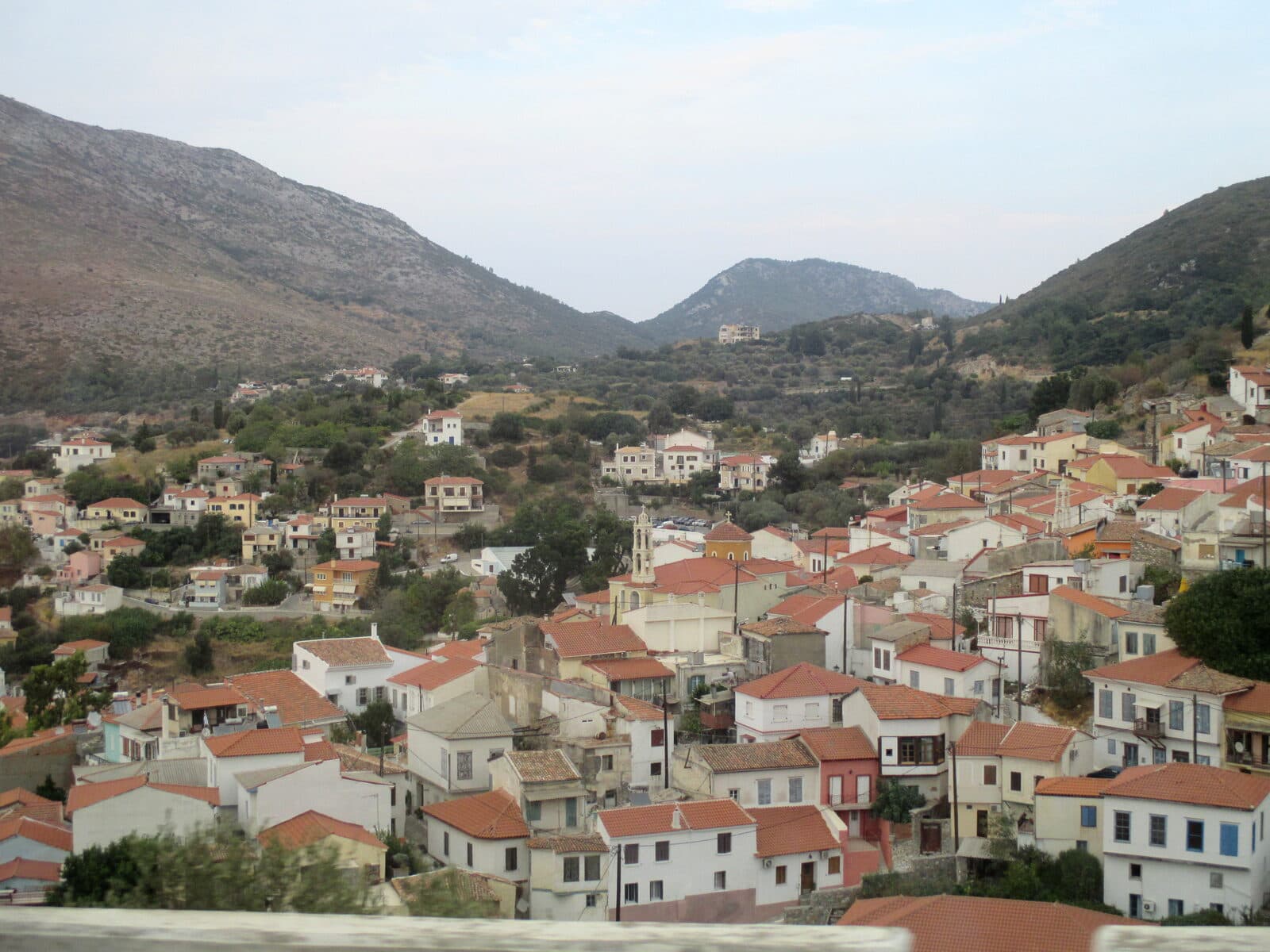
Samos in the Off-Season (Nov-Apr): Is It Worth It?
Mild by northern European standards, genuinely quiet, and not a beach holiday. Here's who it suits and who should wait for summer.

Summarize this article with:
Samos in winter isn't a lesser version of the summer trip: it's a different trip entirely, built around the island itself rather than the beach. Most tourist infrastructure scales right back, so it rewards travellers who know what they're getting.
Weather is mild rather than cold: afternoon highs range from 13.5 °C in January and February to 18.4 °C in November, with more rain than the rest of the year, particularly in the mountains. It's not a beach-weather season.
What's open: many hotels, tavernas and tour operators close for the season, especially smaller, family-run businesses outside Vathy. Vathy and Karlovasi, as year-round working towns, keep more open than the more seasonal resort areas like Kokkari.
Flights and ferries thin out considerably. Direct seasonal flights from northern Europe largely stop, meaning a connection via Athens is the realistic route, and ferry frequency drops.
What still works: the UNESCO sites (Pythagoreio, the Heraion, the Eupalinos Tunnel), the archaeological museum in Vathy, wine tasting at the EOSS cooperative, and a genuinely quiet island experience without another tourist in sight at most sites.
Who it suits: travellers who want to see the island itself, don't need a beach holiday, and don't mind researching specific opening hours and transport in advance. It doesn't suit anyone expecting the lively summer version of Samos.
Rain is the main factor. November averages 116.4 mm and December 156.8 mm, the wettest month of the year. Between November and March there are 8 to 14 rain days a month. Wet spells often last several days in a row, so a short trip can coincide with a grey stretch. Allow spare days if an outdoor plan matters.
The mountains get more of it. The interior around Mount Kerkis and the Ambelos massif receives more rain than the coast, and paths can be muddy or slippery after a wet spell. Check the forecast before a hike, start early, and pick coastal walks or village visits when the high ground is in cloud.
The sea stays at 16 to 19 °C, from about 19 °C in November to 16 °C from January to March. Some locals swim all winter, but for most visitors it is a brief dip, not a beach day. Daylight is short too: sunshine averages 3.5 to 5.5 hours a day in mid-winter, so plan sightseeing for the middle of the day.
April is the turning point. Long-term averages put April highs at about 20 °C, with around 45 mm of rain over six days and 8.5 hours of sunshine a day. The sea is still cool at roughly 16.6 °C, so April suits walking and sightseeing rather than swimming. March is a step behind, with about 16 °C by day and 6.5 hours of sun.
Winter is the season for wetland birds. From roughly November to April, the Alyki salt pan near Psili Ammos fills into a shallow lake up to about 70 cm deep. Its Natura 2000 record counts 304 wintering flamingos, along with wigeon, mallard, teal and shoveler. Migrating birds cross Samos in spring and autumn, so the edges of the off-season reward birdwatchers most.
Hiking comes into its own. Without the summer heat, the waymarked trails are far more comfortable, and the official network names October to December as the best time for the Vourliotes and Manolates loop. The trade-off is short days and slippery ground after rain. Pick a route you can finish in daylight, carry water and tell someone where you are going.
Museums keep the same hours all year. The Archaeological Museum of Vathy publishes 8:30 to 15:30, closed on Tuesdays, in winter as in summer, and its reduced ticket for eligible visitors applies from 1 October to 31 May. It shuts on 1 January, 25 March, Easter Sunday and 25 and 26 December, and entry is free on 6 March and 28 October.
Getting around needs a plan. The airport bus is reported to run Monday to Saturday only, with no Sunday service and a much thinner timetable out of season, and no official KTEL timetable for 2026 could be found. Buses do not reach mountain villages such as Manolates and Vourliotes. Grey taxis have ranks in Vathy, Karlovasi, Pythagoreio and Kokkari, but a hire car keeps a winter trip simple.
Everyday practicalities. Banks open Monday to Thursday from 8:00 to 14:30 and on Friday until 13:30. Shops keep split hours on Tuesday, Thursday and Friday, and the longer opening that tourist areas offer is a summer arrangement. Vathy has the island's general hospital, and the health centre in Karlovasi is staffed 24 hours a day, all year round.
Frequently asked questions
Partly. Vathy and Karlovasi function as normal working towns year-round, but many seasonal hotels, tavernas and tour operators in resort areas like Kokkari close for the winter months.
See Vathy, the island capitalDirect seasonal routes from northern Europe mostly stop outside the summer months. The realistic winter route is a connecting flight via Athens.
See flights and ferries to SamosFor sightseeing and a genuinely quiet island experience, yes. For a beach holiday, no: swimming weather and open beach facilities are a spring-to-autumn proposition on Samos.
See the full month-by-month guideMild, green and quiet. Afternoons reach 13.5 to 15 °C from December to February, with frequent rain and short days. Towns stay lively enough, but resort areas close down until spring.
See Vathy, the island capitalDecember, with 156.8 mm of rain over about 14 rain days on average. January follows with 135.0 mm. Rain often comes in spells of several days, heavier in the mountains than on the coast.
See the dry and rainy seasons explainedOnly briefly. The sea falls to about 16 °C from January to March, and 17 °C in December. A few hardy swimmers go in all year, but beach facilities are closed and most visitors stay out.
See Samos' best beachesReady to go?
Pick a Samos day out and book it in a few taps
Live prices and free cancellation on most tours, confirmed instantly.
Opens our booking partner in a new tab. Prices and availability are shown live there.